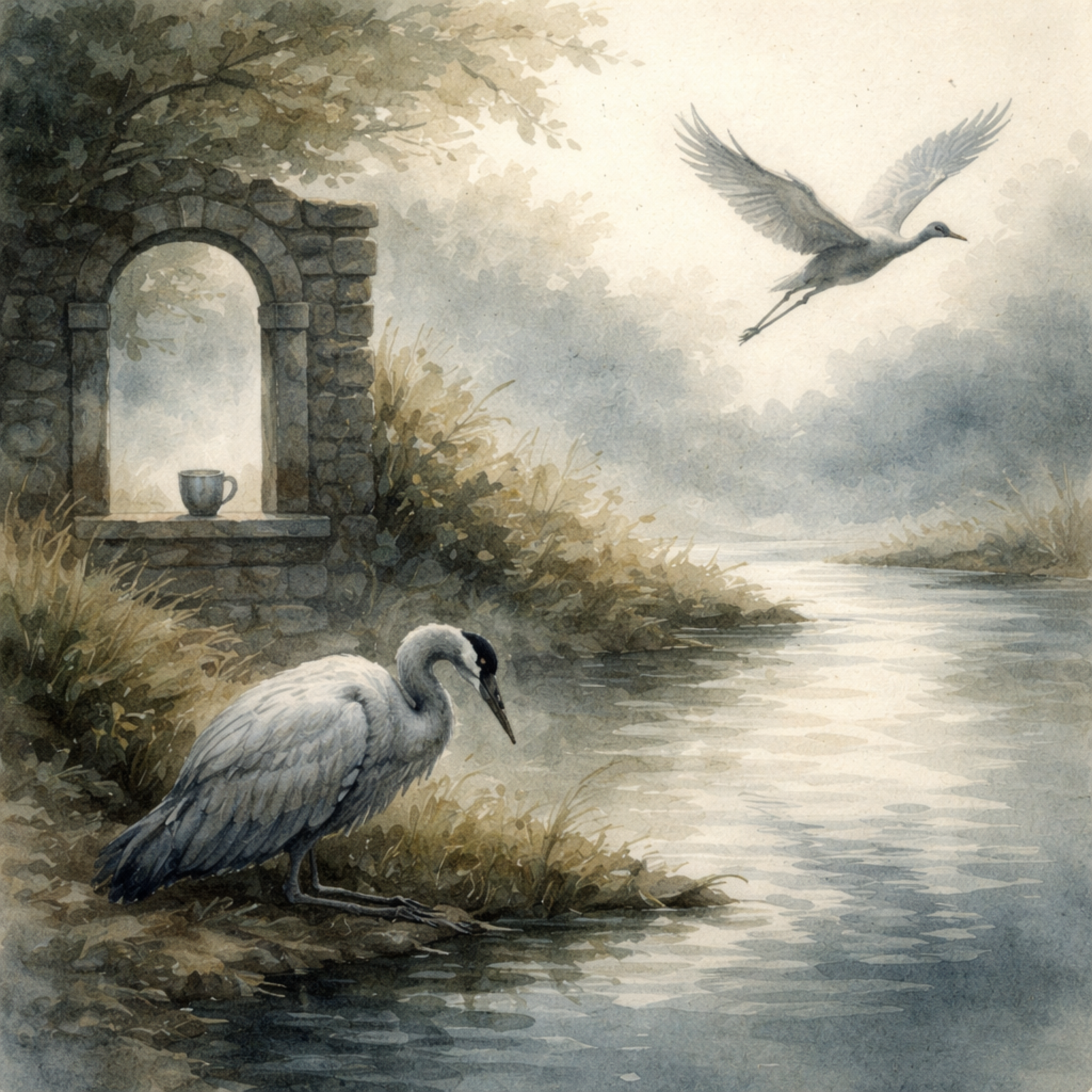
Two cranes lived beside a long river bend, where the water slowed enough to remember itself.
For twenty seasons they nested there, mending reeds together, trading watchful silences, calling each other home at dusk. Nothing about their life was fragile. It had been tested by storms and hunger and the long ache of migration.
Near the path to the marsh stood a stone gate, old as the bend itself. Travelers rested there. Sometimes they left gifts: a ribbon, a coin, a cup.
One autumn, the female crane began to watch the cup.
It had always been there. She knew that. She had even drunk from it once or twice herself, years ago, when the days were lighter and the river less crowded. But now, whenever her mate lingered near the gate, something in her tightened.
“One day,” she said, not looking at him, “that cup will take more than it gives.”
He laughed softly. “It never has.”
“Then promise me,” she said, turning at last, “you won’t touch it again.”
The word promise landed like a rope pulled too tight.
He could have refused. The cup had no hold on him. But the way she stood—wings close, eyes afraid—unmade him.
“I won’t,” he said.
At first, he kept the promise easily. But the river grew colder. The days shortened. And something unnamed settled between them, heavy as fog. When she asked where he had been, her voice already carried an answer. When he spoke, she listened for cracks.
So he learned to pass the gate alone. To drink quickly. To wipe the rim clean. Not because he loved the cup—but because he loved the nest, and feared even more the sound of it breaking.
When she finally asked outright, he did not dodge.
“I failed,” he said. “Not often. Not proudly. But honestly.”
Her feathers flared. “Then how many times have you lied?”
“I don’t know,” he answered. “I stopped counting when truth began to cost more than silence.”
He tried harder then. Avoided the gate altogether. Let the thirst pass. But each morning she measured his words, and each night she weighed his eyes.
“You’ve broken it,” she said again and again. “I don’t know if it can be mended.”
The days wore him thin.
One evening, shaking, he returned to her.
“I drank,” he said. “Once. And I am sorry. I wish I had not. I wish I had come to you sooner.”
She stiffened.
“NO, you’re not,” she said. “I knew I couldn’t trust you. I knew it.”
And with that, she turned and flew to the far reeds, leaving the air cold where she had been.
He stayed by the river until dawn, watching the current carry everything away except the gate, and the cup resting quietly upon it—untouched, unoffended, unchanged.
And as the sun rose, the crane understood at last:
the gate had never been guarding the cup at all.