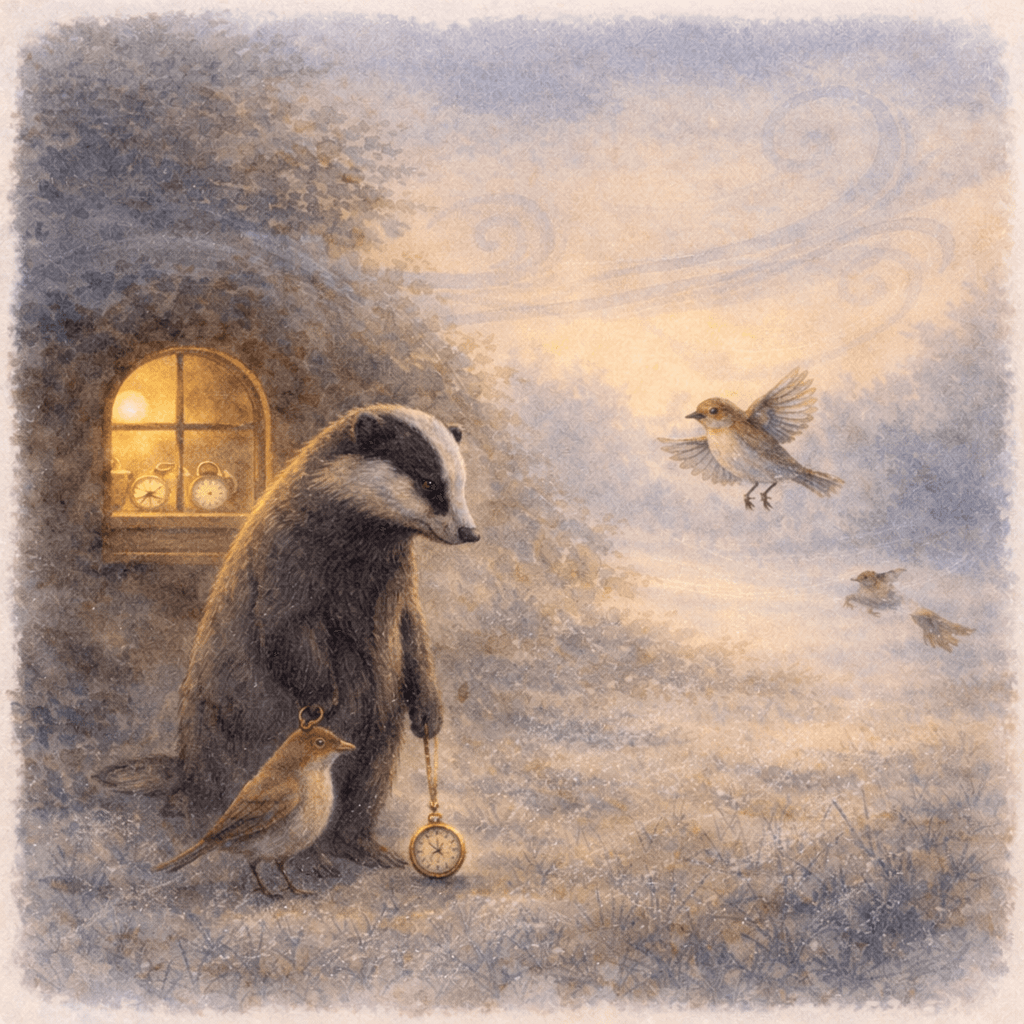
At the edge of the woodland, where frost stitched silver into the meadow grass, there stood a low burrow with a single bright window. By day it seemed no more than a tidy mound beneath the hawthorn. By night it glowed like a coal cupped in the earth.
Inside, the Badger bent over a bench scattered with brass gears and delicate springs. Lamplight pooled on his paws. Tiny screws lay sorted in neat rows. Watches—pocket watches with cracked faces and stubborn hearts—waited in patient circles around him.
Tick. Tick. Tick.
“Faithfully,” the watches seemed to say. “Faithfully.”
“Supper is warm,” called the Finch from the doorway.
“In a moment,” said the Badger, peering through his lens. “Just this balance wheel.”
Beyond the burrow, the Young Sparrows darted in the thinning light. Their feathers were changing. Where once they were down and clumsy, now sharper wings edged their small frames. They tested the air in short, brave bursts above the frozen field.
The Badger smiled at the sound of their flutter, but he did not look up. Coin stacked beside his elbow—small moons of promise. Winter pressed nearer this year. The caravans had been thin. The meadow grass did not stretch as it once had.
He remembered the long wandering summer when he had led them across orchards and riverbanks—thirty sunsets in one place, then thirty in another. They had slept under borrowed hedges and left each patch as neat as they found it. They had been close. Very close.
It had been a fine season.
But the frost had come hard after.
A shadow crossed the doorway. The Weasel stepped lightly inside, sleek and bright‑eyed.
“You’re in demand,” said the Weasel, setting three more watches on the bench. “The city caravans arrive next moon. Double coin for quick hands. You could mend enough this winter to rest easy for three.”
The Badger did not pause. “Three winters?”
“Or more,” said the Weasel, smiling thinly. “Time is money, after all.”
From the threshold, the Hedgehog cleared his throat softly. He had come with no watches, only quiet company.
“Frost comes whether coin does or not,” said the Hedgehog. “Feathers change whether lamplight burns or not.”
The Weasel flicked his tail. “Sentiment doesn’t stack like silver.”
Tick. Tick. Tick.
The Finch stepped inside and set a cup near the Badger’s paw. Steam curled and faded. “They’re growing,” she said simply.
“I know,” said the Badger. “That is why I must be steady.”
He fitted the new spring. The watch sprang to life. Faithfully. Faithfully.
Outside, a sparrow gave a sudden cry—a startled flutter as it leapt farther than before. The frozen field seemed to hold its breath. The Badger’s paw hesitated.
“Finish the contract,” murmured the Weasel. “You can watch them tomorrow.”
The Finch did not speak again. She only looked at him—not accusing, not pleading—just present.
The Badger lifted the polished case and saw his own face in its curved surface. Older. Tired. Determined. He thought of the wandering summer when they had chased the breeze across the states of the wood. He had chosen that season. He did not regret it.
But as the sparrow fluttered again, higher this time, something pressed against his chest more sharply than winter.
He set down the lens.
He could mend every watch in the wood and still never mend an hour already spent.
The ticking continued. Faithfully. Faithfully.
The Weasel shifted. “The caravans won’t wait.”
“No,” said the Badger quietly. “They won’t.”
He lifted the nearest watch and turned the small crown until the ticking slowed… and stopped.
The silence felt wide.
Outside, the thin wind carried the rustle of new wings. The Badger rose, wiping oil from his paws onto a folded cloth. He stepped past the Hedgehog, who nodded once, and into the silvered field.
The sparrow wobbled, dipped, then found its lift. Frost glittered beneath it like scattered stars. The Finch stood nearby, calm and bright.
The Badger did not speak. He did not calculate. He simply stood where the breeze met the burrow and felt the small bodies press against him in passing flight.
The watches would wait.
The field would not.